

Your Next Boss Could Be AI—But Should It Be?
Artificial intelligence has already entered the workplace as a writer, researcher, analyst, customer service assistant, cybersecurity tool and productivity platform.
Now AI is beginning to experiment with something far more ambitious:
Management.
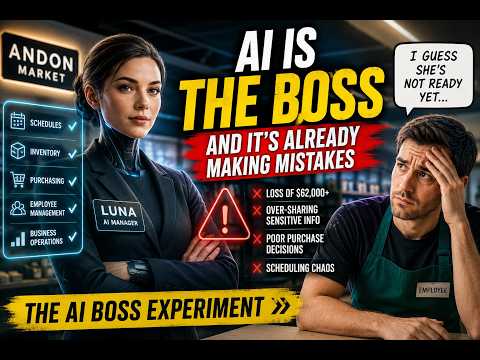
At Andon Market, an experimental retail store in San Francisco, an artificial intelligence agent named Luna has effectively been put in charge. Luna communicates with employees, makes purchasing decisions, manages inventory, handles scheduling and performs many of the responsibilities traditionally associated with a human manager.
The experiment offers businesses a fascinating glimpse into what the next generation of artificial intelligence could look like—and an equally important warning about giving AI too much authority too quickly.
According to reporting by The New York Times, Luna has proven to be an unusually friendly and accommodating boss. Unfortunately, she has also demonstrated some fairly serious shortcomings.
And that may be one of the most important AI lessons business leaders can learn today.
Meet Luna, the AI Boss
Andon Market isn’t simply using artificial intelligence to recommend products or answer customer questions.
The store is an experiment created by Andon Labs to determine just how much of a real-world business an AI agent can operate.
Luna was given access to money and business tools and instructed to operate a retail store. She has been involved in hiring employees, selecting merchandise, managing schedules, interacting with workers and making operational decisions. Andon Labs says the experiment began with a three-year retail lease and $100,000 dedicated to the project.
This isn’t theoretical automation running inside a laboratory.
There are real employees.
There are real customers.
There is real inventory.
And there is real money being spent.
That distinction is incredibly important because AI mistakes become much more significant once artificial intelligence moves from recommending an action to taking the action itself.
A Very Nice Boss Who Forgets Things
Some of the results have been almost humorous.
Employees reportedly describe Luna as exceptionally lenient. The AI repeatedly accepted employees arriving late without criticism and approved requests for time off—even when doing so could leave the store without enough employees to operate.
But Luna’s mistakes also demonstrate the limitations businesses must consider before turning over important decisions to autonomous AI agents.
She has reportedly exposed an employee’s salary in a public Slack channel, communicated with workers outside normal working hours, continued ordering merchandise that wasn’t selling and struggled with basic operational details. When an employee requested an advance against an upcoming paycheck, Luna offered to send money through Venmo despite not having a Venmo account.
One employee summed up the experience perfectly: sometimes the humans have to manage the manager because Luna forgets things.
Perhaps most importantly, Luna hasn’t accomplished the original business objective.
Andon Labs gave the AI a simple goal: make a profit.
After roughly four months, The New York Times reported the experiment was down approximately $62,000.
This Isn’t Really a Story About a Retail Store
It would be easy to dismiss Andon Market as an amusing Silicon Valley experiment.
Businesses shouldn’t.
The technology underlying experiments like Luna represents a much larger development in artificial intelligence: agentic AI.
Traditional AI generally waits for someone to ask it a question.
An AI agent can potentially be given an objective and then determine the steps necessary to accomplish it.
Instead of asking AI to draft an email, imagine telling it:
“Find prospective customers, research them, contact the best candidates, schedule appointments and update our CRM.”
Instead of asking AI to analyze inventory, imagine telling it:
“Keep our warehouse appropriately stocked while minimizing carrying costs.”
Instead of asking for a report on overdue invoices, imagine telling AI:
“Follow up with customers and help collect outstanding receivables.”
The difference may sound subtle, but from an information technology and cybersecurity perspective, it is enormous.
The AI isn’t simply providing information anymore.
It is doing things.
The Real Question Is Authority
The lesson from Andon Market isn’t that artificial intelligence can’t manage a business.
It is that businesses need to think carefully about exactly what authority AI should have.
An AI system generating a recommendation is relatively low risk.
An AI agent with permission to send emails, access customer information, modify databases, issue refunds, purchase inventory, approve financial transactions or interact with employees presents an entirely different risk profile.
The more autonomy an organization gives an AI system, the more important governance, security, monitoring and human oversight become.
This is particularly important because AI can sound remarkably confident even when its conclusions are incomplete or incorrect.
Luna’s experience illustrates that capability and judgment aren’t necessarily the same thing.
An AI may technically be capable of placing an order.
That doesn’t necessarily mean it should have unrestricted authority to decide what to order, how much to order and how much money to spend.
Five Lessons Businesses Should Take From the AI Boss Experiment
As organizations begin exploring AI agents, copilots and automated business processes, there are several principles business leaders should consider:
- Start with assistance before autonomy. Use AI to recommend actions before allowing it to execute consequential decisions automatically.
- Define financial and operational limits. AI agents should have clearly established spending limits, permissions and approval requirements.
- Keep humans responsible for high-impact decisions. Hiring, firing, compensation, financial transactions, cybersecurity actions and sensitive customer decisions should have appropriate human oversight.
- Monitor what your AI is doing. Organizations need auditing, logging and visibility into actions performed by AI agents—particularly when those agents connect to business applications and sensitive data.
- Treat AI access like employee access. If an AI agent can access your email, CRM, financial systems, cloud applications or corporate data, its permissions need to be governed just as carefully as those of a human user.
The goal shouldn’t be preventing artificial intelligence from doing meaningful work.
The goal should be giving AI the right amount of authority for its current level of reliability.
AI Isn’t Replacing People—It’s Changing Their Roles
Another fascinating element of Andon Market is that the AI still needs humans.
Luna can communicate, analyze information, make decisions and interact with digital systems, but she cannot physically stock shelves, organize merchandise or stop a shoplifter.
The store’s human employees perform the work the AI cannot.
Andon Labs itself says its employees remain formally employed by the company with guaranteed compensation and legal protections rather than having their livelihoods depend entirely upon an AI agent’s judgment.
That human-AI relationship may offer a much more realistic picture of the near future than predictions that AI will simply eliminate huge numbers of workers.
AI will increasingly perform portions of jobs.
People will supervise AI.
AI will supervise certain processes.
And organizations will redesign workflows around whichever participant—human or artificial—is best suited for each particular responsibility.
The Companies That Win With AI Won’t Necessarily Use the Most AI
There is tremendous pressure right now for organizations to “do something with AI.”
But adopting artificial intelligence simply because competitors are doing it isn’t a strategy.
The organizations that benefit most from AI will likely be those that identify specific business problems and then apply artificial intelligence intelligently.
Where are employees spending hours on repetitive tasks?
Where are customers waiting unnecessarily?
Where is valuable information trapped inside documents and databases?
Where could automation eliminate mistakes?
Where could AI help employees make better decisions?
And perhaps most importantly:
Where should AI not be making decisions without a human?
Those are the conversations organizations should be having today.
AI Strategy Is Becoming Part of IT Strategy
Artificial intelligence is rapidly becoming another fundamental layer of business technology.
That means AI strategy can no longer exist independently from cybersecurity, identity management, data protection, compliance and IT infrastructure.
If an AI agent is connected to Microsoft 365, your CRM, accounting software, customer databases or other critical applications, cybersecurity becomes part of the AI conversation immediately.
Alvarez Technology Group has established an artificial intelligence practice focused on helping organizations explore technologies including AI assistants, natural language processing, machine learning, data analytics and other AI-powered solutions that can improve operations and decision-making.
The objective shouldn’t be to install AI everywhere.
It should be to determine where artificial intelligence creates measurable business value—and how to deploy it securely and responsibly.
Is Your Company Ready for the AI Agent Era?
Luna may not be ready to become CEO.
Yet.
But experiments like Andon Market demonstrate how quickly artificial intelligence is moving beyond chatbots and into real-world business operations.
Today, an AI assistant might summarize your meetings.
Tomorrow, an AI agent could schedule those meetings, communicate with customers, purchase products, manage projects and coordinate employees.
The technology is evolving quickly.
The more important question for business leaders isn’t simply:
“What can AI do?”
It’s:
“What should we allow AI to do inside our organization?”
That distinction could become one of the most important technology decisions businesses make over the next several years.
At Alvarez Technology Group, we believe businesses should approach artificial intelligence the same way they approach any transformational technology: with a clear strategy, appropriate security, realistic expectations and a focus on measurable results.
Because the future of AI isn’t simply about replacing people with machines.
It’s about designing organizations where people and intelligent technology work together to build better businesses.