

How a Telephone Giant Predicted the Digital World Decades Before It Arrived
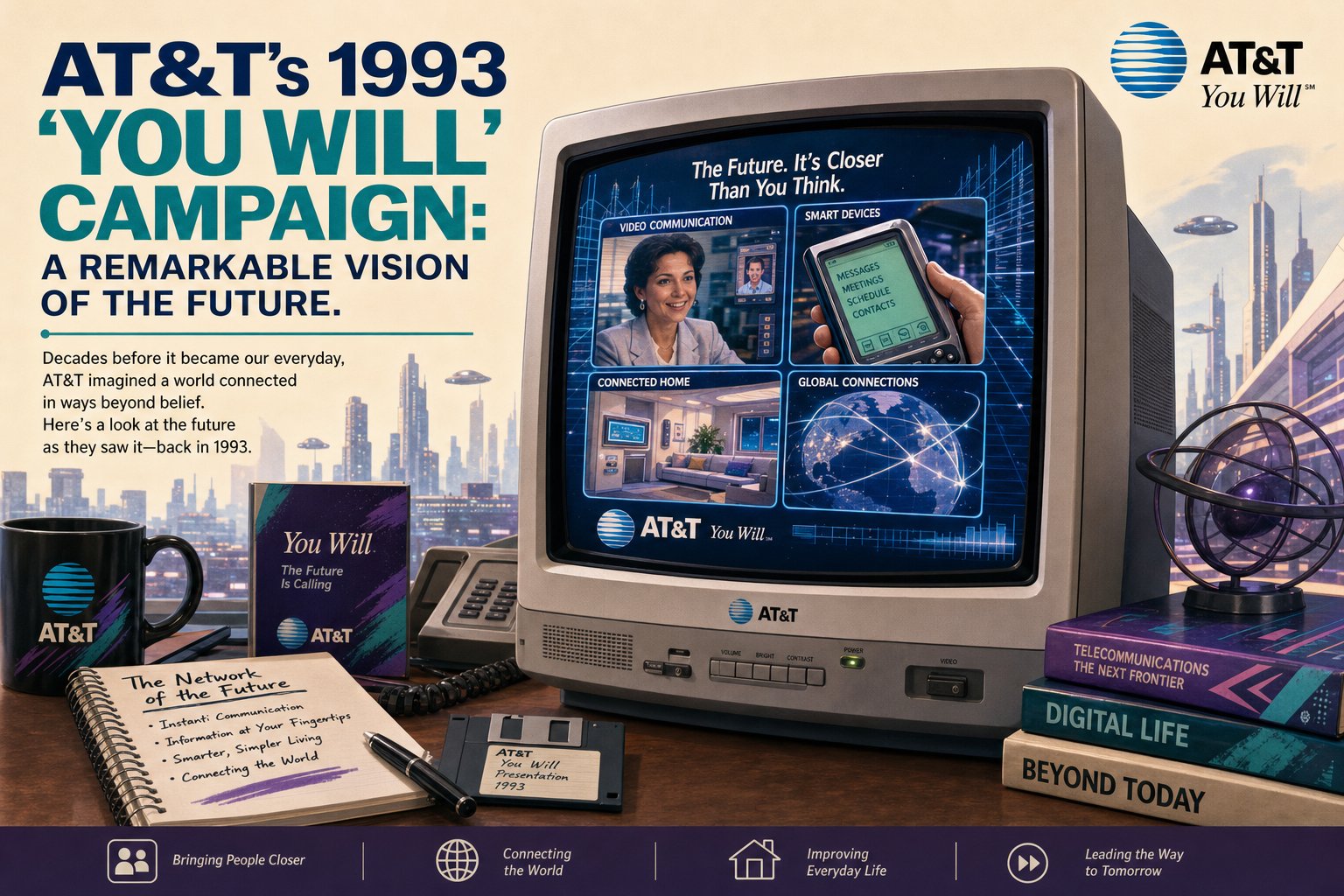
In the annals of advertising history, few campaigns have proven as remarkably prescient as AT&T’s 1993 “You Will” series of television commercials. At a time when the World Wide Web was barely a year old and the average American had never heard the word “internet,” AT&T dared to paint a picture of a connected future that seemed, at the time, almost fantastical. Looking back more than three decades later, the campaign stands as one of the most accurate technological prophecies ever committed to a television screen — and a fascinating window into how the telecommunications giant saw its own role in shaping the world to come.
The Campaign That Stopped America in Its Tracks
Directed by acclaimed filmmaker David Fincher and featuring the smooth, authoritative narration of Tom Selleck, the “You Will” commercials aired during some of the most-watched television events of 1993, including Super Bowl XXVII. Each spot opened with a simple, conversational question — “Have you ever…” — followed by a vision of some future technology that seemed almost science fiction to viewers of the era.
The commercials were not selling a specific product. Instead, they were selling a vision — a carefully crafted narrative of tomorrow in which technology would seamlessly integrate into every aspect of daily life. And at the end of each spot, after the futuristic scenario had unfolded, came the quiet, confident tagline:
“You will. And the company that will bring it to you: AT&T.”
It was bold. It was ambitious. And as history would ultimately prove, it was breathtakingly accurate.

What AT&T Predicted — And Got Right
What makes the “You Will” campaign so extraordinary is not just that it imagined future technologies, but that it described them with such functional specificity. These weren’t vague promises of “a better tomorrow.” They were concrete depictions of tools and services that billions of people would eventually use every single day.
Sending a Fax from the Beach
One of the earliest spots showed a man vacationing on a beach, effortlessly sending a fax from a portable device. In 1993, fax machines were bulky, stationary office fixtures. The idea of sending documents wirelessly from a remote location seemed absurd. Today, we do something even more remarkable — we send entire document packages, signed electronically, from our smartphones while sitting on that same beach.
Borrowing a Book from a Library Thousands of Miles Away
AT&T imagined a user accessing a digital library from a remote location, browsing and retrieving books without ever setting foot inside a physical building. This was a precise description of what we now know as digital libraries, e-books, and platforms like Google Books, Project Gutenberg, and the vast online catalog systems used by universities and public libraries worldwide. Amazon’s Kindle store, launched in 2007, made this an everyday reality for millions of consumers.
Crossing a Toll Without Stopping
The commercials depicted a driver passing through a toll booth without slowing down, the transaction happening automatically. In 1993, this seemed like something out of The Jetsons. Today, electronic toll collection systems like E-ZPass on the East Coast, FasTrak in California, and similar programs worldwide have made stopping at toll booths largely a thing of the past.
Attending a Meeting in Your Pajamas
Perhaps no prediction in the entire campaign feels more culturally resonant today than AT&T’s vision of videoconferencing from home. The commercial depicted someone participating in a business meeting via a screen — dressed comfortably, from their personal space. After the COVID-19 pandemic of 2020 forced the world into remote work, platforms like Zoom, Microsoft Teams, and Google Meet became the backbone of global business. The “meeting in your pajamas” became not just a possibility but a daily reality for hundreds of millions of workers.
Carrying Your Medical History in Your Wallet
AT&T foresaw a future where an individual’s complete medical records could be stored on a small, portable device and accessed by healthcare providers anywhere in the world. This vision directly anticipates today’s Electronic Health Records (EHR) systems, patient health apps, and the ongoing push for universal medical data portability. While the healthcare industry still wrestles with interoperability, the fundamental concept AT&T described in 1993 is now the accepted standard of modern medicine.
Learning from a Talking Tutor
One commercial showed a child interacting with an interactive, responsive educational program — essentially an AI tutor that could answer questions and guide learning in real time. In 2026, AI-powered educational platforms are among the fastest-growing sectors in ed-tech, with tools like Khan Academy’s AI tutor, intelligent learning management systems, and personalized education platforms transforming how students of all ages access knowledge.
Getting Concert Tickets from an ATM-Like Device
AT&T depicted a person purchasing event tickets from a standalone kiosk. While the specific delivery mechanism has evolved, self-service ticketing — through both physical kiosks and digital platforms like Ticketmaster and StubHub — is now completely standard.
Tucking a Child in Bed from a Hotel Room
In what may be the campaign’s most emotionally powerful vignette, a parent on a business trip is shown saying goodnight to their child via a two-way video screen. FaceTime, WhatsApp video calls, and dozens of other video communication tools have made this tender moment available to any parent with a smartphone and a WiFi connection. It is estimated that billions of video calls are made every single day around the world.
Why the Campaign Mattered Beyond Marketing
From a marketing perspective, the “You Will” campaign was a masterclass in brand positioning. AT&T wasn’t just advertising telephone service — it was claiming ownership of the entire technological future. By associating its brand with each of these compelling, human-centered visions, AT&T planted itself firmly in the American imagination as the essential bridge between the present and tomorrow.
But the campaign’s significance goes well beyond marketing strategy. It represented something genuinely rare in corporate communications: a company willing to think in decades rather than quarters.
The commercials were developed with input from AT&T’s Bell Labs — one of the most storied research and development institutions in human history, the birthplace of the transistor, the laser, Unix, and countless other foundational technologies. The researchers and engineers who contributed to the “You Will” campaign weren’t guessing. They were describing technologies that were already in various stages of development within their own labs and across the broader research community.
In this sense, the “You Will” campaign was less a prediction and more a declaration of intent — a public statement that AT&T understood where technology was heading and intended to be the company that got you there.

The Irony of History
Here is where the story takes its most fascinating turn. Despite being arguably the most accurate corporate vision of the technological future ever presented to the American public, AT&T did not ultimately dominate the specific technologies it described.
The internet — the infrastructure that would actually deliver nearly every one of these predictions — was built and commercialized largely through the efforts of other companies. Search engines, social media platforms, streaming services, and mobile computing were pioneered by startups and tech companies that barely existed, or didn’t exist at all, when those commercials aired.
AT&T’s own history through the 1990s and 2000s was marked by significant turbulence — divestitures, mergers, failed acquisitions, and the eventual sale of its consumer operations. The company that confidently declared “You will. And the company that will bring it to you: AT&T” found itself watching much of that future arrive via other hands.
This is not a story of failure, however. It is a story of remarkable vision meeting the unpredictable chaos of technological disruption. AT&T saw the destination clearly. The roads that led there turned out to be more complicated than anyone anticipated.
Lessons for Technology Businesses Today
At Alvarez Technology Group, we work with businesses every day that are grappling with the same fundamental challenge AT&T faced in 1993: how do you position your organization for a technological future that is still taking shape?
The “You Will” campaign offers several enduring lessons:
1. Understand technology trends at a human level. AT&T’s most powerful insight wasn’t technical — it was human. Every commercial was framed around a human need or desire: staying connected with family, accessing information, making travel easier, improving healthcare. The technology was the enabler, not the point. Businesses that lead technological change understand that their customers don’t buy technology — they buy outcomes.
2. Long-term vision is a competitive asset. In an era of quarterly earnings pressure and rapid market change, the ability to think and communicate in long arcs is increasingly rare and increasingly valuable. The “You Will” campaign demonstrated that a credible, well-articulated vision of the future can be a powerful differentiator — one that shapes customer perception and organizational culture for years.
3. Vision without execution is just a commercial. AT&T’s story is also a cautionary tale. Seeing the future clearly is not sufficient. Organizations must build the operational agility, strategic focus, and cultural resilience to actually navigate toward the future they envision. The companies that ultimately delivered on AT&T’s 1993 vision were those that combined clear direction with relentless execution.
4. Technology disruption doesn’t wait. The speed at which AT&T’s predicted future arrived — and the degree to which it arrived through unexpected channels — underscores a fundamental truth of the modern technology landscape: disruption is not a distant threat to be managed. It is a present reality to be embraced.
Conclusion: A Campaign Worth Remembering
More than three decades after those 30-second spots first aired on American television, the “You Will” campaign deserves to be remembered not just as clever advertising, but as a genuine cultural artifact — a snapshot of a moment when one company glimpsed the connected world that was coming and had the courage to describe it out loud.
Every technology that AT&T depicted in those commercials exists today. Most of them are so woven into the fabric of daily life that we no longer find them remarkable. We send documents from the beach. We read library books on our tablets. We tuck our children in from hotel rooms on the other side of the world. We attend meetings in our pajamas.
You will, AT&T told us.
And we did.