

The AI Gold Rush Has a $3.5 Trillion Problem. Who Pays If the Boom Goes Bust?
Technology companies are spending unprecedented sums building the infrastructure behind artificial intelligence. But a troubling new Gartner forecast suggests the industry’s financial expectations may be getting dangerously ahead of reality, raising important questions for businesses investing in AI.
Across America, an extraordinary construction boom is underway.
Massive data centers are rising from the ground. Technology companies are purchasing enormous quantities of computer chips, negotiating long-term electricity contracts, and spending billions of dollars to build the infrastructure needed to power artificial intelligence.
Microsoft, Amazon, Google, and a growing collection of specialized AI companies are racing to secure computing capacity for what many believe will become the defining technology of the next generation.
The investment is breathtaking.
But there’s a problem.
According to new research from technology advisory firm Gartner, the industry may be spending far more money building artificial intelligence infrastructure than it can reasonably expect to earn from it over the next several years.
And the potential financial consequences are enormous.
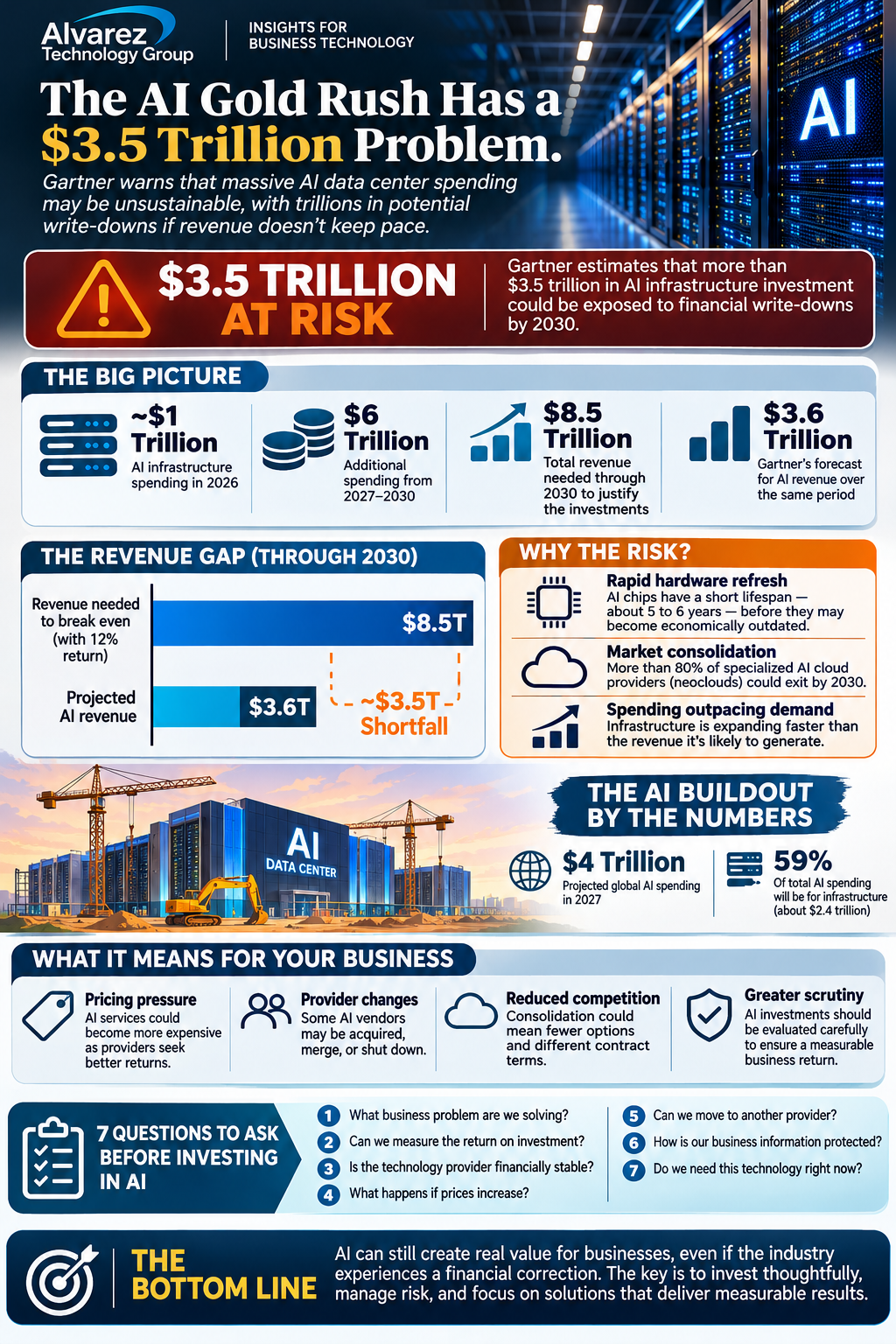
Gartner estimates that more than $3.5 trillion in AI infrastructure investment could be exposed to financial impairment by 2030 if current spending patterns continue.
That’s trillion with a T.
It raises a question that business leaders, investors, and technology providers may soon find impossible to ignore.
What happens when the companies building the future of artificial intelligence discover that customers aren’t willing to pay enough to support it?
The Numbers Behind the Artificial Intelligence Boom
In an October 14, 2026 announcement, Gartner outlined the enormous financial commitments being made across the artificial intelligence industry.
The research firm estimates that AI infrastructure providers will spend nearly $1 trillion in 2026 alone.
Between 2027 and 2030, Gartner forecasts another $6 trillion in infrastructure investment.
That spending includes the specialized computing equipment, facilities, and other infrastructure required to support AI systems.
But purchasing the equipment is only part of the financial equation.
Companies must also account for financing expenses and the returns investors expect from committing such substantial amounts of capital.
Gartner calculates that AI data center owners would need to generate approximately $8.5 trillion in cumulative revenue through 2030 to cover their announced capital spending, financing costs, and achieve an assumed 12% return on invested capital.
Here’s where the numbers become troubling.
The research firm forecasts that enterprise and consumer AI revenue attributable to AI data centers will reach no more than $3.6 trillion over that period.
That represents a substantial mismatch between the revenue needed to justify the investments and the revenue Gartner expects the infrastructure to generate.
The figures are projections based on Gartner’s assumptions, not audited results or guaranteed outcomes. They also measure revenue attributable to infrastructure rather than every dollar of economic value AI might create across the broader economy.
Nevertheless, they suggest that the current spending trajectory may be difficult to sustain.
The concern isn’t that artificial intelligence has no future. It’s that the infrastructure being built to support that future may be expanding faster than its economics can justify.
Why Are Technology Companies Spending So Much?
To understand the situation, consider what makes modern artificial intelligence possible.
Large AI models require enormous computing resources, particularly during training and when serving millions of user requests.
Those computations rely heavily on specialized processors known as graphics processing units, or GPUs.
Originally developed for computer graphics, GPUs have become essential components of modern AI computing infrastructure.
They are expensive, power-hungry, and increasingly central to the business strategies of the world’s largest technology companies.
Data centers also require sophisticated networking equipment, storage systems, cooling technology, electrical infrastructure, and extensive physical facilities.
And as artificial intelligence becomes more capable, the demand for computing resources continues to grow.
Technology companies face a difficult competitive decision.
If they invest too little, they risk falling behind competitors and losing customers.
If they invest too much, they risk building expensive infrastructure that may never generate adequate financial returns.
For now, many appear more concerned about losing the AI race than about the potential consequences of overspending.
That competitive pressure helps explain why investment continues to accelerate even as analysts question whether the numbers make financial sense.
The $3.5 Trillion Warning Doesn’t Mean AI Is About to Collapse
It’s important to understand what Gartner is actually predicting.
The firm isn’t saying that $3.5 trillion has already disappeared or that artificial intelligence is about to become worthless.
Instead, Gartner is warning that the amount of money invested in AI infrastructure could substantially exceed the economic returns generated by those assets.
When companies discover that equipment, facilities, or other investments are worth less than their recorded accounting value, they may be required to recognize a financial impairment, commonly called a write-down.
Consider a simplified example.
Imagine a technology company spends $100 million building an AI computing facility.
Its financial projections assume the facility will attract enough paying customers to justify that investment.
But several years later, competing companies offer similar computing services at dramatically lower prices, and the facility generates substantially less revenue than expected.
The company may determine that the recoverable value of the investment is significantly below its carrying value.
Depending on applicable accounting rules and circumstances, it may have to record an impairment charge.
That charge recognizes a reduction in the value of an asset. It does not necessarily represent an equivalent amount of new cash leaving the business at that moment.
Scale that possibility across hundreds of AI data centers and trillions of dollars in spending, and the potential financial consequences become significant.
Gartner’s longer-term projections suggest that more than $4 trillion in AI infrastructure asset value could be exposed to write-down risk through 2032.
The firm also emphasizes that these potential write-downs are not necessarily imminent.
AI Hardware Has Another Problem: It Gets Old Quickly
There’s another complication facing the industry.
Unlike a commercial building that may remain useful for decades, specialized AI computing hardware can become economically outdated much sooner.
Chipmakers continue developing more powerful and efficient processors.
New generations of AI hardware may deliver better performance while reducing the cost of individual computations.
That’s excellent news for organizations wanting affordable AI services.
But it creates a difficult financial challenge for companies that invested billions in earlier generations of equipment.
In an October report published by Fierce Network, Gartner analyst Will Sommer discussed AI chips having an expected lifespan of approximately five to six years.
That means companies investing heavily in computing equipment today may face another expensive replacement cycle before their original investments deliver satisfactory returns.
The equipment doesn’t necessarily stop working after that period.
But it may become less competitive as newer processors deliver better performance or lower operating costs.
Businesses that own AI infrastructure must therefore generate sufficient revenue before changing technology makes their equipment less valuable.
It’s a challenge that has existed in computing for decades, but the extraordinary scale of today’s AI investments makes the financial exposure much larger.
A Coming Shakeout Among AI Cloud Companies?
Gartner’s concerns extend beyond the largest technology companies.
The firm expects substantial consolidation among specialized cloud infrastructure providers, sometimes called neoclouds.
These companies have emerged to supply the computing power required by organizations developing and running AI models.
Unlike established cloud companies with large portfolios of business services, neocloud providers often concentrate heavily on GPU-based computing capacity.
That specialization can be an advantage when demand is strong.
But it can also create significant financial risk.
Many specialized providers must make enormous capital investments before earning sufficient revenue to cover those costs.
They may also face competition from larger companies that can fund infrastructure investments through profits generated by other business operations.
Gartner predicts that more than 80% of neocloud providers could cease operating independently by 2030.
That doesn’t necessarily mean 80% will go bankrupt.
Some may be acquired. Others may merge, form partnerships, or change their business models.
Nevertheless, Gartner’s forecast points toward a potential market dominated by fewer, larger AI infrastructure providers.
For businesses considering long-term relationships with specialized AI vendors, that possibility deserves attention.
Why Should Small Businesses Care About Trillion-Dollar AI Investments?
Most small and mid-sized businesses aren’t building data centers or purchasing millions of dollars in specialized AI processors.
So why should they be concerned about financial problems facing the companies that are?
Because many businesses are increasingly dependent on services provided by those same companies.
Artificial intelligence is being integrated into accounting platforms, customer relationship management software, marketing applications, cybersecurity systems, productivity tools, and everyday business workflows.
Organizations are adopting these services with the expectation that they’ll remain available, affordable, and supported over time.
But if the financial structure supporting the technology changes, businesses may experience consequences of their own.
Those consequences could emerge in several ways.
1. AI Subscription Prices Could Change
Many AI services are currently competing aggressively for customers.
Some offer free access, introductory discounts, or pricing that may not fully reflect the long-term cost of providing their services.
If AI infrastructure providers face pressure to improve profitability, software vendors may eventually adjust prices or restrict features included in existing subscriptions.
That doesn’t mean widespread price increases are inevitable.
Competition and improving hardware efficiency could also reduce costs.
But businesses should avoid making long-term financial assumptions based exclusively on today’s promotional pricing or introductory service arrangements.
2. Some AI Providers May Disappear
Imagine building an important business process around an AI service, only to discover that the provider has been acquired, discontinued a product, or substantially changed its terms.
Suddenly, your organization may need to find a replacement, migrate information, retrain employees, or rebuild integrations.
For businesses relying on specialized AI platforms, vendor stability should be an important purchasing consideration.
Organizations should understand how their information can be exported, whether applications can operate with alternative providers, and what happens if a vendor discontinues service.
3. Cloud Service Competition Could Change
If Gartner’s consolidation forecast proves accurate, the number of independent companies offering specialized AI computing capacity could decline substantially.
Fewer providers may eventually mean less competition in certain market segments.
That could affect service pricing, contract terms, and the range of available options.
On the other hand, larger and more financially stable providers may be better equipped to maintain reliable infrastructure and invest in security.
The impact will depend on how the market develops.
4. AI Investments May Face Greater Financial Scrutiny
Businesses are already being encouraged to adopt artificial intelligence as quickly as possible.
But Gartner’s research suggests that even the largest technology companies are still working through difficult questions about AI economics.
That should encourage smaller organizations to ask similar questions before committing resources.
Is the proposed AI solution addressing a measurable business problem?
Will it reduce operating costs, improve service, generate revenue, or produce another clearly defined benefit?
What will it cost to implement, train employees, maintain integrations, and protect sensitive information?
And what happens if the service becomes more expensive or disappears?
These aren’t reasons to avoid AI.
They’re reasons to approach it as a business investment rather than a technological trend.

Artificial Intelligence Can Be Valuable Even if the Industry Overspends
It’s worth remembering that technological breakthroughs and financial bubbles aren’t mutually exclusive.
The internet provides a familiar example.
During the late 1990s, investors poured enormous sums into internet companies and telecommunications infrastructure.
Many businesses failed when the dot-com bubble burst.
But the underlying technology didn’t disappear.
The internet continued to transform commerce, communications, entertainment, and nearly every aspect of modern business.
The companies that survived eventually built enormous businesses around technology that had initially attracted unrealistic financial expectations.
Artificial intelligence could follow a similarly complicated path.
Some companies may overspend. Others may fail. Investors could lose substantial amounts of money.
Yet AI could still become an indispensable part of the global economy.
There are important differences between today’s AI expansion and the earlier internet boom, including the enormous resources and established revenue streams of several leading technology companies.
The historical comparison is not a prediction that the outcomes will be identical.
But it illustrates an important principle.
A technology can change the world even when many of the companies financing its early expansion fail to earn the returns they expected.
Gartner Still Expects AI Spending to Accelerate
Interestingly, Gartner’s warnings about financial sustainability haven’t prevented the research firm from forecasting continued growth in AI spending.
In a separate November 12, 2026 report, Gartner projected that worldwide artificial intelligence spending would reach approximately $4 trillion in 2027.
Of that amount, approximately $2.4 trillion would be directed toward AI infrastructure, representing about 59% of total AI spending.
Those figures describe global spending across AI markets in 2027, rather than the cumulative infrastructure revenue projections used in Gartner’s impairment analysis.
The distinction matters.
Industry spending can continue growing even when the companies making those investments struggle to earn acceptable financial returns.
In fact, that’s one of the central tensions Gartner is highlighting.
Demand for AI capabilities may be substantial while the financial competition to deliver those capabilities remains extremely challenging.
Both conditions can exist simultaneously.
Seven Questions Businesses Should Ask Before Investing in AI
Given the uncertainty surrounding the AI infrastructure market, businesses should evaluate their technology decisions carefully.
1. What Business Problem Are We Solving?
Every AI investment should begin with a defined objective.
Whether the goal is improving customer service, reducing repetitive work, or increasing employee productivity, the expected benefit should be clear.
2. Can We Measure the Return on Investment?
Establish measurable goals before implementation.
Track costs, employee time, productivity improvements, accuracy, and other outcomes relevant to the project.
Remember to include subscriptions, implementation expenses, training, maintenance, and oversight when evaluating financial returns.
3. Is the Technology Provider Financially Stable?
Consider the provider’s history, ownership, financial condition, customer base, and support arrangements.
Financial stability cannot be guaranteed, but vendor evaluation can help identify avoidable risks.
4. What Happens if Prices Increase?
Review contract terms and determine whether the service will remain affordable if subscription or usage-based pricing changes.
Businesses should understand how their costs may grow as more employees begin using the technology.
5. Can We Move to Another Provider?
Evaluate data portability, integration requirements, and possible alternatives.
Whenever practical, avoid designing essential operations around technology that would be extremely difficult or expensive to replace.
6. How Is Our Business Information Protected?
Artificial intelligence services may process sensitive customer records, employee information, internal documents, or proprietary business data.
Organizations should review vendor security controls, privacy policies, data retention practices, and access management capabilities.
Employees should also receive guidance about which information is appropriate to share with AI services.
7. Do We Need This Technology Right Now?
Not every organization needs to adopt every emerging AI feature immediately.
Sometimes the best decision is to begin with a limited pilot, evaluate the results, and expand only when the benefits justify additional investment.
A measured approach allows businesses to gain experience without committing large amounts of money to unproven applications.
The Real AI Opportunity Isn’t Spending More. It’s Getting More Value.
The enormous spending commitments being made by the world’s largest technology companies can make artificial intelligence seem like an industry where success depends on investing billions of dollars.
But most businesses operate under very different circumstances.
They don’t need to build massive computing facilities.
They need technology that helps employees work more effectively, protects customer information, improves operational efficiency, and supports sustainable growth.
For those organizations, the value of AI won’t be measured by how many GPUs a provider owns or how much money it spends on data centers.
It will be measured by the practical results delivered.
A modest AI application that reliably saves employees several hours each week may be more valuable than an expensive and complicated system with no clearly demonstrated business benefit.
Likewise, a well-integrated automation tool may offer a stronger return than purchasing an enterprise AI platform simply because it promises revolutionary capabilities.
The companies most likely to benefit from artificial intelligence won’t necessarily be those that adopt the most AI products.
They may be the organizations that make the smartest decisions about which technologies actually support their business goals.
Is the AI Bubble About to Burst?
That may be the question attracting the most attention.
But Gartner’s analysis doesn’t establish that an immediate collapse is inevitable.
It identifies a serious potential imbalance between infrastructure spending and projected revenue.
Future outcomes will depend on variables that remain difficult to predict.
AI adoption could accelerate faster than expected.
New applications could create additional demand.
Advances in hardware and software efficiency could reduce the cost of delivering AI services.
Or competition could push prices lower while the financial burden of maintaining expensive infrastructure continues to grow.
Different companies will experience those developments differently.
Some may achieve extraordinary success.
Others may struggle to justify their investments.
For businesses purchasing AI products and services, the best response isn’t panic or blind optimism.
It’s preparation.
Understand your vendors. Protect your data. Evaluate costs carefully. Maintain alternatives for critical services. And invest in technology based on its demonstrated value rather than industry excitement.
Because whether the AI industry experiences a financial correction or continues expanding, businesses still need reliable, secure, and affordable technology.
The most important question isn’t whether artificial intelligence will change the economy. It’s whether the businesses investing in it are making decisions that will still make financial sense when the excitement fades.
Making Smart Technology Decisions in an Uncertain AI Market
At Alvarez Technology Group, we believe artificial intelligence can create meaningful opportunities for small and mid-sized businesses when it is implemented thoughtfully and supported by a sound technology strategy.
But adopting emerging technology shouldn’t mean accepting unnecessary financial, operational, or cybersecurity risks.
Organizations need to understand how new systems fit within their existing infrastructure, how sensitive information will be protected, and whether the investment delivers measurable benefits.
From managed IT services and cybersecurity to cloud technology, business continuity, and long-term IT planning, a well-designed technology strategy helps businesses evaluate opportunities while managing uncertainty.
The AI industry may be spending trillions to build the next generation of computing infrastructure.
But your business doesn’t need a trillion-dollar budget to make intelligent technology decisions.
Before making your next major AI investment, make sure the technology makes sense for your business today and remains sustainable tomorrow.
Contact Alvarez Technology Group to discuss your organization’s technology strategy, cloud services, cybersecurity requirements, and plans for responsible AI adoption.
Sources and Further Reading:
- Fierce Network: Gartner Warns AI Data Center Capital Spending Is Unsustainable as $3.5 Trillion Write-Down Risk Looms
- Gartner: Over $3.5 Trillion of AI Infrastructure Spending Could Be Exposed to Impairment by 2030
- Gartner: Prepare for AI Market Consolidation — Capital Write-Downs Could Exceed $4 Trillion by 2032
- Gartner: AI Infrastructure Spending Forecast to Represent 59% of Global AI Spending in 2027
- TechTarget: Gartner Forecasts Massive AI Infrastructure Write-Downs