

Google I/O 2026: Gemini Moves from AI Assistant to Digital Agent
Google I/O 2026 made one thing clear: Google no longer sees artificial intelligence as simply a tool that answers questions. Its vision is now centred on AI agents that can understand context, complete multi-step assignments and take action across the applications people use every day.
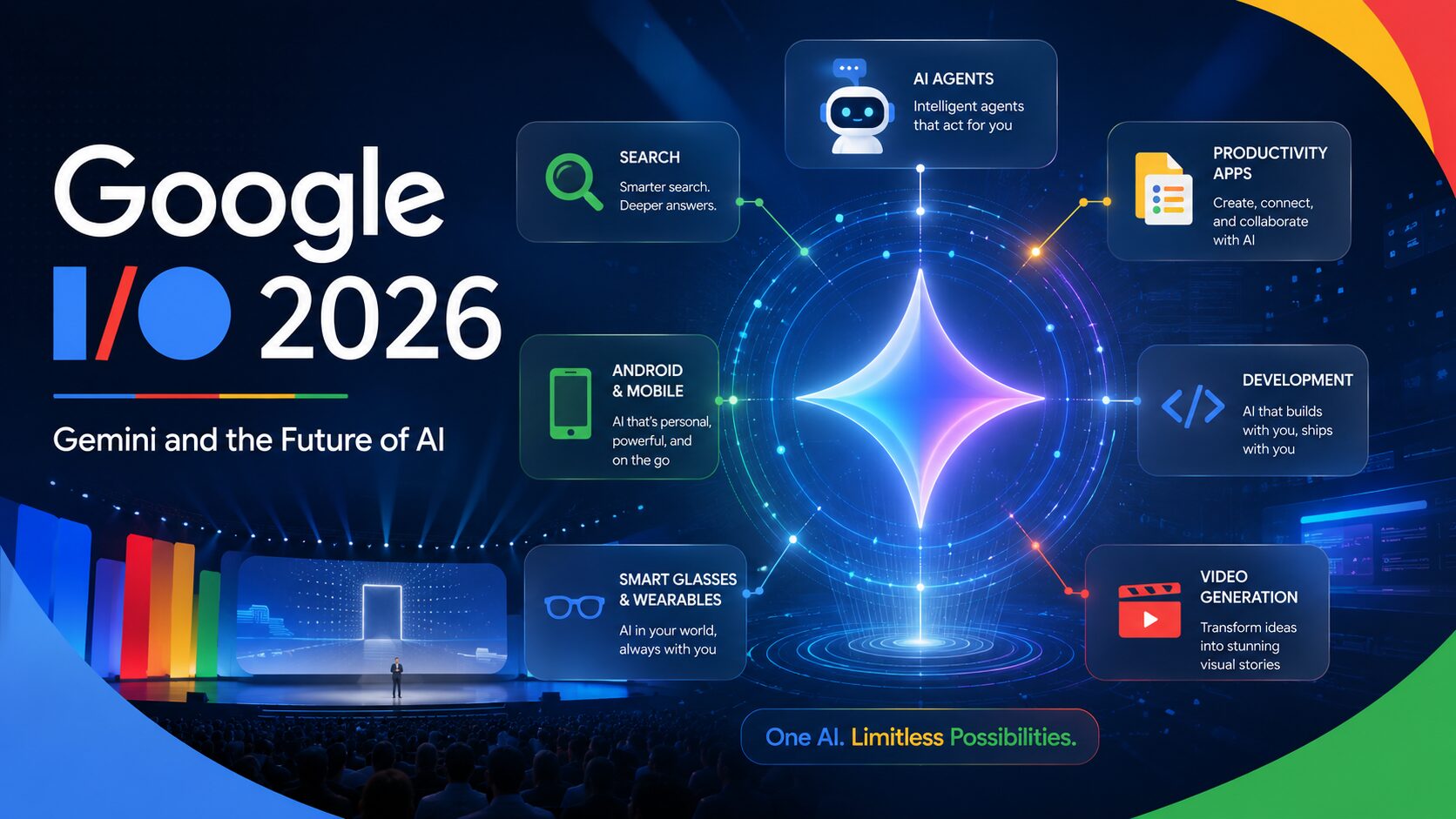
Held May 19–20, the annual developer conference introduced major updates involving Gemini, Google Search, Workspace, Android, creative tools and application development. Google described this new phase as the “agentic Gemini era”—a shift from AI that responds to prompts toward AI that can help carry out entire workflows.
For businesses, this could represent one of the most significant changes to workplace technology since the arrival of cloud computing.

Gemini 3.5 Flash Brings Intelligence and Speed Together
At the centre of Google I/O was Gemini 3.5 Flash, the first model in the company’s new Gemini 3.5 family.
Google says the model combines advanced reasoning with the speed required for practical AI agents. It is designed to handle longer, more complicated assignments involving planning, coding, research and the use of external tools. Gemini 3.5 Flash is already available through Google Antigravity, the Gemini API, Google AI Studio and Android Studio.
This combination of speed and reasoning is important. Earlier AI systems were often effective at answering an individual question but struggled when asked to manage a lengthy process. Newer agentic models are being designed to break a goal into steps, use the appropriate tools, evaluate their progress and continue working until the assignment is complete.
Gemini 3.5 Flash has also become the default model in Google Search’s AI Mode worldwide, bringing its agentic capabilities to one of the most widely used technology platforms in the world.
Gemini Spark Turns AI into an Active Assistant
One of the most consequential announcements was Gemini Spark, a cloud-based personal AI agent that can continue working even after a user closes a laptop or locks a phone.
Unlike a traditional chatbot, Spark is intended to perform ongoing work under the user’s direction. It can connect with Workspace applications such as Gmail, Docs and Slides, monitor recurring activities and build complete workflows involving several different sources of information.
Google demonstrated examples such as reviewing monthly credit card statements for unexpected subscriptions, monitoring emails for important deadlines, combining meeting notes from different sources and preparing both a project document and the accompanying email.
Spark is designed to request permission before completing higher-risk actions, such as sending an email or spending money. Users also decide whether to activate it and which applications it is permitted to access.
For organizations, this points toward a future in which employees may delegate repetitive administrative processes to persistent digital agents. However, it also reinforces the need for strong identity management, access controls, data governance and clearly defined rules governing what an AI agent may do.
Daily Brief Organizes Information Before the Workday Begins
Google also introduced Daily Brief, an opt-in Gemini feature that reviews connected services and prepares a personalized morning summary.
Daily Brief can examine Gmail for urgent messages, identify upcoming Calendar events and organize relevant follow-up information into a prioritized overview. Rather than simply listing notifications, it is designed to suggest possible next steps based on the user’s activities and goals.
For professionals facing overloaded inboxes and crowded calendars, this type of AI-generated briefing could make it easier to identify what requires immediate attention. It also demonstrates how AI is becoming embedded within daily operations instead of remaining in a separate chatbot window.
Gemini Omni Expands AI-Powered Video Creation
Google used I/O 2026 to introduce Gemini Omni, a multimodal model that can generate and edit content from different combinations of text, images, video and audio references.
The initial version focuses heavily on video. Users can upload existing footage or images and then describe the changes they want in conversational language. Gemini Omni can modify backgrounds, add cinematic camera movement, remix material and preserve greater consistency between characters and scenes.
Omni is being integrated into the Gemini app, Google Flow, YouTube Shorts Remix and YouTube Create. Google says videos created with Omni include its SynthID digital watermark, which is intended to help identify AI-generated material.
These capabilities could give marketing teams, educators and content creators access to sophisticated video production without requiring the same level of specialized equipment or editing experience. At the same time, organizations will need policies covering disclosure, copyright, brand accuracy and the responsible use of synthetic media.
Google Search Is Becoming Multimodal and Agentic
Google is also making its most significant changes to Search in decades.
The company announced an intelligent Search box capable of accepting more than conventional text queries. Users will increasingly be able to search using combinations of text, images, files, video and open Chrome tabs. Gemini 3.5 Flash now powers AI Mode by default, allowing Search to interpret more complex questions and support longer research processes.
Google is also developing information agents that can continue tracking a topic or completing a search-related assignment rather than providing only a one-time page of results.
For businesses, this means online discovery is moving beyond traditional keywords and links. Websites will still need strong, authoritative content, but that content must also be structured clearly enough for AI systems to understand, summarize and cite accurately.
Google Workspace Adds Voice-First Productivity
Gemini is becoming more deeply integrated into Google Workspace through several new voice and productivity features.
Gmail Live lets users ask spoken questions about their inbox and receive synthesized answers. Instead of manually searching several messages, a user could ask for a flight gate number, a customer update or details about an upcoming event.
Docs Live allows users to talk through an idea while Gemini organizes the information, develops a structure and helps create an initial draft. With permission, it can incorporate relevant material from Gmail, Drive, Chat and the web. Google Keep is receiving similar capabilities that can turn an unstructured verbal “brain dump” into organized notes and lists.
Google also introduced Google Pics, an AI-powered image creation and editing application. Pics allows users to select individual objects, reposition or resize them, edit text inside images and translate written content while attempting to preserve the original design. It will also integrate with Workspace applications including Slides and Drive.
Together, these changes show Google’s effort to make voice and natural conversation primary ways of working with business applications.
Developers Get an Agent-First Development Platform
Google I/O 2026 also brought substantial changes for software developers.
Google Antigravity 2.0 is a standalone development environment designed to coordinate multiple AI agents. These agents can work in parallel, create specialized sub-agents and perform scheduled assignments across Google AI Studio, Android and Firebase.
Google also introduced Managed Agents in the Gemini API. Through a single API call, developers can create an agent that reasons, uses tools and runs code inside an isolated Linux environment. These environments can preserve files and state between interactions, making them better suited to lengthy development or automation tasks.
Google AI Studio is gaining Workspace integrations, a mobile application and native Android support. Developers can build an Android application from a natural-language prompt and move a project from AI Studio into Antigravity for further development and deployment.
This could significantly reduce the time required to prototype internal tools, customer applications and business automations. It does not eliminate the need for professional software development, cybersecurity testing or quality control, but it may allow development teams to move from concept to working prototype much faster.
Gemini Is Moving Beyond the Screen
Google also previewed intelligent eyewear powered by Gemini.
The company is developing audio glasses that provide spoken assistance and display glasses capable of showing information in the user’s field of view. The first audio-based models are expected to launch in the fall of 2026.
These devices are intended to provide directions, messaging, photography and real-time assistance without requiring users to constantly look at a phone. While the immediate market may be consumer-focused, similar technology could eventually affect field services, logistics, healthcare, training and remote technical support.
What Google I/O 2026 Means for Business
The biggest message from Google I/O was not a single model or application. It was the transition from generative AI to operational AI.
Organizations are moving toward systems that can:
- Understand information across multiple applications
- Monitor events and respond to defined triggers
- Complete multi-step business processes
- Generate documents, images, software and video
- Continue working after the original user has stepped away
- Interact with employees through natural voice conversations
This creates enormous opportunities for productivity, but it also introduces new risks. An AI agent with access to email, files, calendars and business systems must be governed as carefully as any employee account or software integration.
Businesses should begin by identifying a small number of controlled, measurable use cases. Good starting points may include summarizing internal information, preparing first drafts, organizing meeting notes, assisting with customer communications or automating repetitive administrative work.
Security policies, user permissions, data retention, employee training and human approval procedures should be established before agents are allowed to perform sensitive actions.
Preparing for the Agentic Workplace
Google I/O 2026 showed that AI is rapidly becoming part of the operating layer of modern business technology.
Gemini is no longer being positioned simply as a chatbot. It is becoming an intelligence platform that connects Search, Workspace, Android, creative applications, development environments and emerging wearable devices.
Organizations do not need to adopt every new feature immediately. They do, however, need a plan for evaluating AI tools, securing their data and helping employees use these capabilities responsibly.
Alvarez Technology Group can help your organization assess its technology environment, strengthen cybersecurity protections and develop a practical AI strategy aligned with your operational goals. The future of AI is becoming more connected, more proactive and more capable—and businesses that prepare thoughtfully will be in the strongest position to benefit.