

The Rise of the EREV: How Ford and Dodge are Rewiring the Electric Truck
If you’ve been following the automotive industry’s push toward electrification, you’re likely familiar with the usual acronyms: BEV (Battery Electric Vehicle) and PHEV (Plug-in Hybrid Electric Vehicle). But as the market matures and the reality of commercial and heavy-duty use sets in, a “new” acronym is taking center stage in 2026: the EREV.
Extended-Range Electric Vehicles (EREVs) are suddenly the hottest topic in the automotive world, especially in the pickup truck segment. Both Ford and Dodge (under the Ram brand) are making massive multi-billion-dollar pivots toward this technology.
But what exactly is an EREV, and why are major automakers betting their flagship trucks on it? Let’s break down the tech.
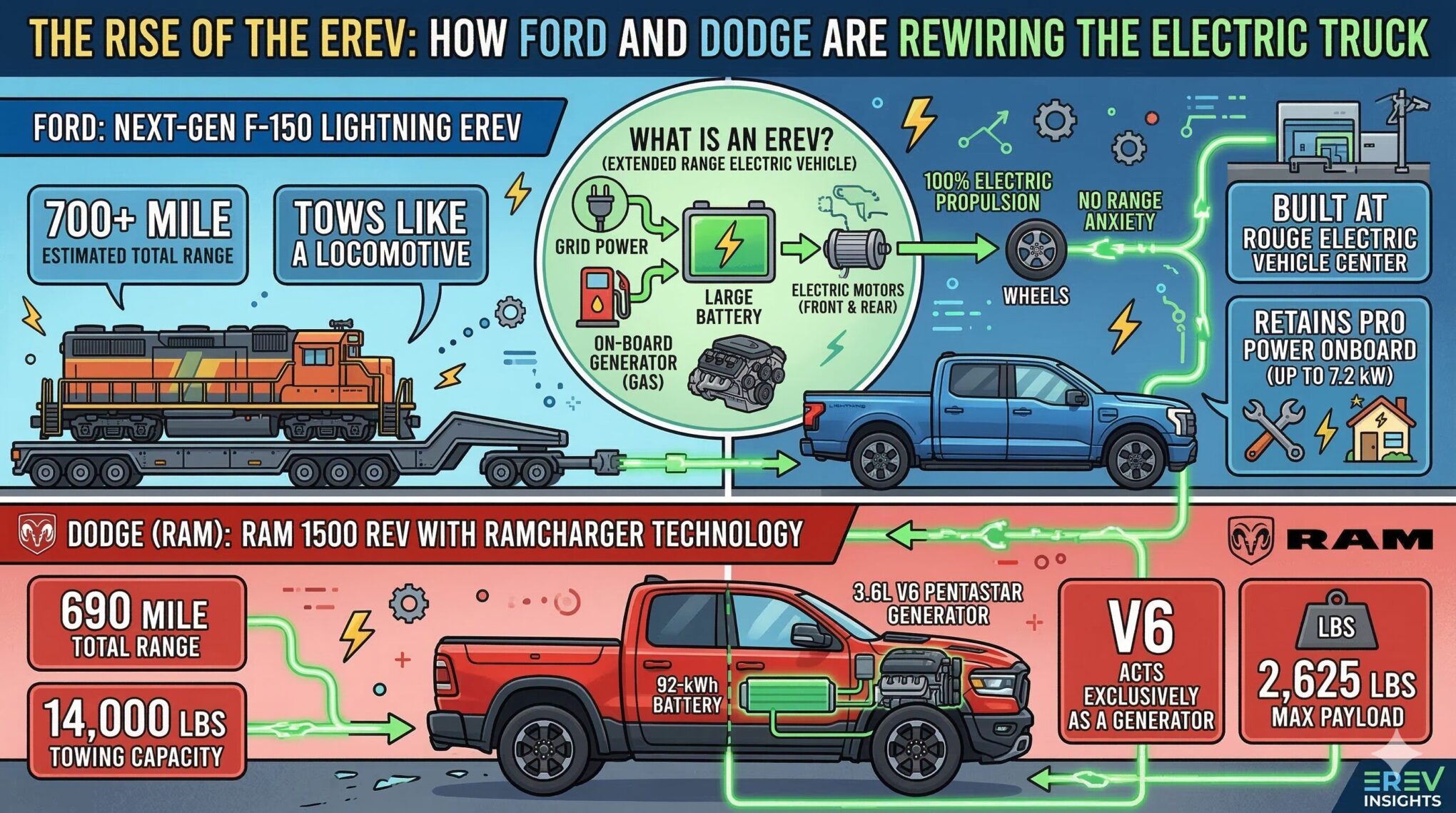
What is an EREV? (And How is it Different from a Hybrid?)
At first glance, an EREV sounds a lot like a traditional plug-in hybrid. Both have batteries you can plug into the wall, and both have gas tanks. However, the fundamental engineering is completely different.
In a traditional hybrid or PHEV, both the electric motor and the gasoline engine can physically turn the wheels.
In an EREV (often called a Series Hybrid), the gasoline engine has absolutely no mechanical connection to the drive wheels. The vehicle is propelled 100% by electric motors. The internal combustion engine acts strictly as an onboard electrical generator.
Think of a diesel-electric locomotive: the massive diesel engines don’t turn the train’s wheels; they generate electricity for the electric motors that actually drive the train. An EREV works the same way.
The result? You get the smooth, silent, instant-torque driving experience of a pure EV, but when the battery gets low, the gas generator kicks on to recharge it on the fly, eliminating range anxiety.

The Problem EREVs Solve: Towing
If you’ve ever tried to tow a heavy load with a pure battery-electric truck, you know the fatal flaw: range drops by upwards of 50%. A truck boasting 300 miles of range might only get 120 miles with a trailer attached, forcing drivers to unhitch and find a fast charger every two hours. For businesses, contractors, and fleet operators, this simply isn’t viable.
Here is how the legacy automakers are using EREVs to solve this.
Dodge’s Powerhouse: The Ram 1500 REV (Ramcharger)
Stellantis is hitting the market hard with the upcoming 2027 Ram 1500 REV (featuring the much-anticipated range-extender tech originally teased as the Ramcharger).
Built on a massive 92 kWh battery, this truck features a 3.6-liter V6 engine bolted to a 130 kW generator. It boasts staggering specs:
- 663 horsepower and 615 lb-ft of torque
- 0-60 mph in 4.4 seconds
- 14,000 lbs of towing capacity
- An estimated 690+ miles (1,110 km) of total range
Because the V6 is constantly feeding the battery, you can tow a heavy load across the country without ever stopping at a charging station. You just pull up to a standard gas pump, fill the tank, and the onboard generator keeps the electric motors spinning.
Ford’s Massive Pivot: The F-150 Lightning EREV
Ford recently made headlines by announcing a massive pivot in its EV strategy. Recognizing that pure electric trucks were struggling to meet the heavy-duty needs of core truck buyers, Ford officially scrapped its plans for a next-generation pure-electric F-150, replacing it instead with the F-150 Lightning EREV.
Expected to hit the market soon, Ford is promising that the Lightning EREV will “tow like a locomotive” with an estimated 700+ miles of range.
Crucially for businesses, Ford is carrying over its beloved “Pro Power Onboard” feature. Because the truck has a massive battery and a high-output gas generator, it effectively acts as a mobile power station. This allows construction crews, IT disaster recovery teams, or mobile technicians to power entire job sites, server racks, or communications arrays in remote locations for days at a time.
Why This Matters for the Tech & Business World
For businesses managing fleets, the shift to EREVs represents the ultimate “best of both worlds” scenario.
- Lower Operating Costs for Local Driving: For daily, local tasks, these trucks can be plugged in at the depot overnight and run purely on cheap electricity.
- No Downtime: When a vehicle needs to be dispatched across the state or haul heavy equipment, there is no need to plan complex routes around EV charging infrastructure.
- Mobile Infrastructure: The massive power export capabilities of EREVs transform vehicles into mobile grid assets. Whether it’s running power tools, providing emergency backup power during an outage, or keeping critical tech infrastructure online in the field, EREVs offer unprecedented utility.
The Bottom Line
The transition to a fully electric future isn’t a straight line. By adopting EREV technology, Ford and Dodge have realized that to get truck buyers to adopt electric powertrains, they have to remove the compromises.
The EREV isn’t just a stepping stone; for the foreseeable future, it might just be the ultimate blueprint for the modern work vehicle.
Looking for more insights on how emerging technology impacts your business infrastructure? Stay tuned to the Alvarez Technology Group blog for the latest updates.