

The Ghost of the Fire Phone and the AI Era: Inside Amazon’s “Transformer” Smartphone
In 2014, Amazon launched the Fire Phone. Plagued by an unpolished proprietary OS, a lack of mainstream apps, and a gimmick-heavy 3D display that drained the battery, it was discontinued after just 14 months, resulting in a $170 million write-down. It was widely considered one of the biggest tech flops of the 2010s.
Fast forward to March 2026: The mobile landscape is drastically changing, and according to recent leaks, Amazon is ready for a do-over.
Enter Project Transformer.
Rather than attempting to beat Apple and Samsung at their own game by building a traditional app-centric smartphone, Amazon is reportedly developing an entirely new category of mobile device—one built from the ground up for the era of Artificial Intelligence. Here is what business leaders and tech enthusiasts need to know about Amazon’s boldest hardware initiative in years.
The “ZeroOne” Dream Team
Amazon isn’t taking this lightly. Project Transformer is reportedly being developed by a highly secretive, year-old internal team dubbed “ZeroOne,” operating under Amazon’s broader Devices & Services division.
What makes this team notable is its leadership. The division is overseen by Panos Panay, the former Microsoft executive credited with creating the Surface lineup. Spearheading the ZeroOne group itself is J Allard, another Microsoft legend known for his foundational work on the original Xbox and the Zune. With this level of hardware pedigree, Amazon is clearly aiming to create a “breakthrough” gadget rather than a simple iterative update.
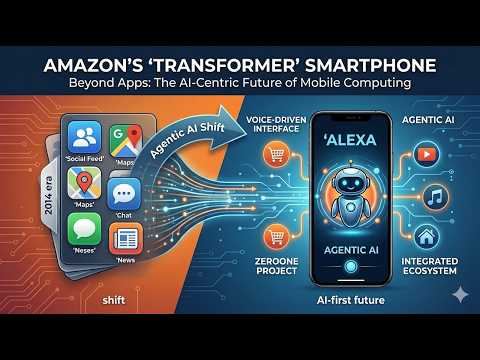
The Shift: From App-Heavy to “AI-First”
The most fascinating aspect of the Transformer project is its core philosophy. Since 2007, the smartphone paradigm has been dictated by app stores. If you want to accomplish a task, you download a specific app.
Amazon’s new device aims to disrupt this model using “Agentic AI.” Envisioned as a voice-driven, AI-centric personalization device, the phone will reportedly rely on a vastly upgraded version of Alexa. Instead of opening an app to hail a ride, order a meal, or buy a product, users will simply converse with the AI assistant, which will perform the actions on their behalf.
By eliminating the need for traditional app stores, Amazon circumvents the iOS/Android duopoly—the very hurdle that killed the Fire Phone.
An Ecosystem Engine
Amazon’s underlying goal hasn’t changed since 2014: they want to keep you inside their ecosystem.
The Transformer is designed to act as a seamless conduit to Amazon’s core services. The AI integration will reportedly make it frictionless to shop on Amazon.com, discover content on Prime Video, listen to Prime Music, and order food through partnered services like Grubhub. By functioning as a continuous connection to the user’s daily life, the device would provide Amazon with invaluable data and drive unmatched consumer loyalty to the Prime subscription model.
The “Dumbphone” Companion Angle
Interestingly, Amazon isn’t putting all its eggs in the traditional “glass slab” basket. Alongside a standard smartphone form factor, the ZeroOne team has reportedly been exploring a stripped-down, minimalist companion device.
Taking inspiration from devices like the Light Phone, this concept leans into the growing cultural movement toward “digital detoxing.” Rather than competing as a user’s primary flagship phone, Amazon could position the Transformer as a secondary “dumbphone” that handles core tasks via AI without the addictive screen time associated with doom-scrolling social media.
What This Means for Business and IT
At the Alvarez Technology Group, we constantly monitor how consumer tech trends inevitably bleed into enterprise environments. If Amazon’s vision of an “app-less, AI-first” mobile device gains traction, the implications for businesses are profound:
- The End of App-Centric Workflows? If users become accustomed to “Agentic AI” handling tasks in their personal lives, they will demand the same frictionless experience in the workplace. Businesses may need to shift their focus from developing enterprise mobile apps to integrating their services with broader AI agents.
- Data Security and Privacy: An AI assistant that manages your shopping, schedule, and communications requires deep access to personal and potentially corporate data. Navigating the security compliance of such “always-listening” hubs will be a critical challenge for IT departments.
- The Rise of Companion Devices in the Enterprise: A minimalist, voice-driven “dumbphone” could be a highly effective corporate device—allowing employees to stay connected to essential communications and AI assistants without the distractions of a traditional smartphone.
The Bottom Line
Reports caution that Project Transformer is still in active development and, like many experimental tech projects, could be shelved before it ever sees the light of day. However, the existence of the project proves that the tech industry is preparing for a post-app future.
Whether Amazon finally strikes gold or repeats the sins of the Fire Phone, the shift toward AI-driven mobile computing is officially underway. We’ll be watching closely.
Stay tuned to the Alvarez Technology Group blog for more insights on how emerging technology impacts the modern business landscape.